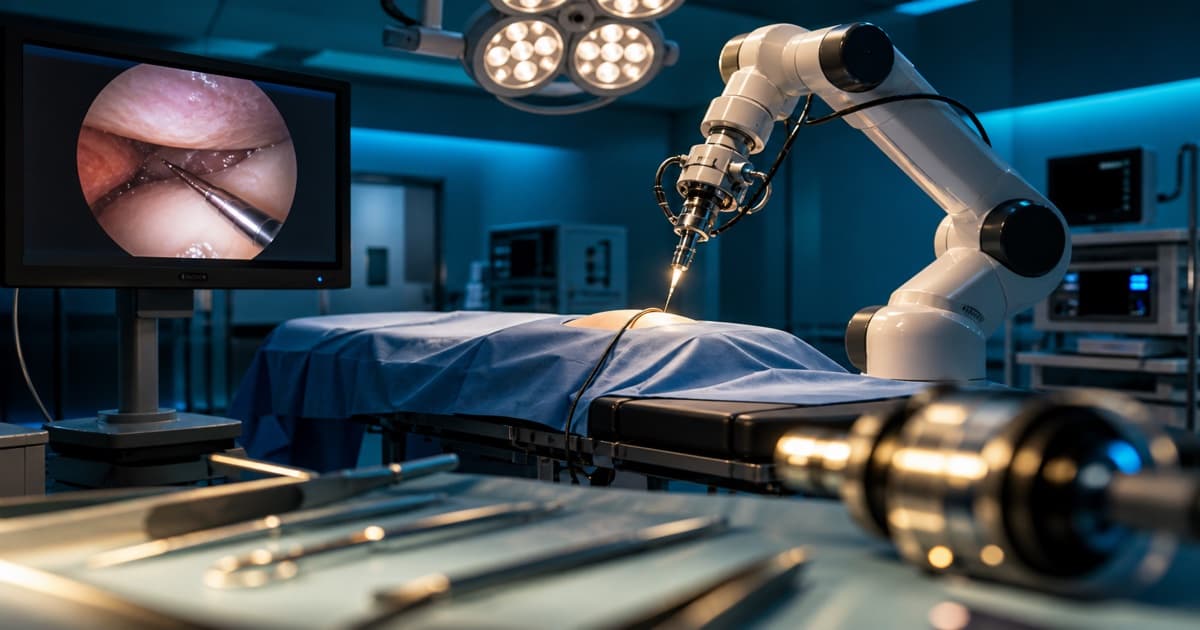
Every March, AAOS sets the agenda for orthopedic surgery — not just what the literature says, but what we'll actually be doing differently over the next five years. The 2026 Annual Meeting in New Orleans offered five signals worth carrying home.
1. Robotic TKA: Past the Tipping Point, Debate Shifts to Value
The headline study from the AAOS 2026 press kit was the multicenter RCT by David Ayers (UMass), randomizing 1,699 TKA patients across robotic-assisted, remote therapeutic monitoring, and standard PT arms. Robotic-assisted TKA demonstrated statistically higher patient satisfaction and quality-of-life scores at one year compared to conventional technique.
This lands on top of a growth curve most of us already know: robotic TKA volume rose 601% from 2015 to 2020. Modeling now projects robotic TKA will represent ~70% of all U.S. primary TKAs by 2030.
Yet the debate is far from settled. A separate analysis of >9,200 patients (2017–2020) showed no reduction in revision rates. AAOS's own position statement notes no significant short-term differences in function or complications versus conventional TKA. System cost ($500K–$1M upfront, cost-effective only at ≥50 cases/year) remains the primary barrier for lower-volume centers.
Where I land: Satisfaction signal is real. Revision signal is absent. The argument now shifts from "does it work?" to "for whom and at what volume does the premium justify itself?" — and that's a more useful question.
No confirmed United Orthopedics robotic launch for 2H 2026 in public disclosures; the U2 Knee's compatibility with the THINK Surgical TMINI platform is an existing clearance, not a new announcement.
2. Hip Approach: The Question Has Changed
The DAA vs. posterior approach debate consumed orthopedic surgery for two decades. At AAOS 2026, the consensus has quietly shifted — not to "DAA wins," but to a different question entirely.
The data are clear enough:
| Metric | DAA | Posterior (modern capsular repair) |
|---|---|---|
| 90-day dislocation rate | 0.84% | 1.75% (historical) / <0.5% (modern capsular repair) |
| Early pain control | Advantage | Narrowing |
| OR time | +14.5 min | Reference |
Modern capsular repair for the posterior approach has substantially closed the dislocation gap — below 0.5% at high-volume centers. The historic DAA advantage in this metric is no longer the clean differentiator it once was.
The Anterior Hip Foundation 2026 meeting, themed "Consensus and Controversy," ran cadaver labs specifically to standardize DAA teaching for fellows and residents. That framing says it all: the approach question is resolved. The training standardization question is what remains.
Clinical bottom line: Volume and surgeon expertise dominate approach selection. Asking "DAA or posterior?" has been replaced by "what's this surgeon's volume and complication profile?" Counsel patients accordingly.
3. ACL + LET/ALLR: The Consensus Era Arrives
This one moved from recommendation to consensus faster than most expected.
The 2025 International Consensus Statement (Arthroscopy, 2025) passed 100% unanimous among assembled experts:
For active patients aged ≤25 years undergoing ACL reconstruction with hamstring autograft, a lateral extra-articular procedure (LEAP) is strongly recommended to reduce graft failure.
AAOS 2026 maintained its Moderate Recommendation (CPG) for LEAP in select high-risk patients, with AAOS Now's March issue featuring a dedicated article on expanding indications.
The anchor remains the STABILITY trial:
| Group | Graft failure at 2 years |
|---|---|
| ACLR alone | 11% (34/298) |
| ACLR + LET | 4% (11/291) |
RRR 67%, NNT 14.3. A 2026 meta-analysis (AJSM) comparing LET vs. anatomic ALLR found LET superior for internal rotation resistance with no significant difference in anterior tibial translation — mild overconstraint risk notwithstanding. This explains the 80% preference for LET over anatomic ALLR among sports medicine surgeons.
2026 emphasis — women and adolescents: Higher baseline ligamentous laxity, higher ACL tear incidence, and historically elevated graft rupture rates make female athletes and young patients the demographic with the most to gain. AAOS 2026 presentations specifically called this out, and LEAP indications are now explicitly extended to this group and to all revision ACLR.
The technique evolution: Jeremy Burnham MD presented the Loop and Tack LET approach (all-suture cortical button, metal-free fixation) — a lower-profile option that addresses implant concerns in younger patients.
4. Rotator Cuff Patch Augmentation: The Guidelines Finally Spoke
The rotator cuff augmentation space has accumulated a confusing array of products, mechanisms, and conflicting trial data. AAOS 2026 brought the first CPG update (finalized August 2025, presented at the meeting) that actually grades the evidence:
| Intervention | Grade | Rationale |
|---|---|---|
| Bioinductive collagen implant (e.g., REGENETEN) | ★★★★ Strong Recommendation | Reduces retear, improves PROs; best evidence in small-to-medium tears |
| Human dermal allograft (e.g., GraftJacket) | ★★★ Moderate Recommendation | Upgraded from Limited; structural reinforcement for large/revision tears |
| Porcine xenograft (e.g., Restore) | ❌ Not Recommended | Immune risk + insufficient evidence |
The key mechanistic distinction: Bioinductive implants promote tissue regeneration but contribute no structural strength (not a load-bearing scaffold). Human dermal allografts provide biomechanical augmentation but are not bioinductive. These are complementary tools, not interchangeable substitutes. Tear size, chronicity, and tissue quality drive the selection.
Two additional signals from the meeting:
- AAOS launched the Orthobiologics Registry — acknowledging that the evidence base still needs long-term real-world data
- The ASES Bio-Advocacy Work Group published survey data showing clinical adoption remains limited despite guideline support, primarily due to coding and cost barriers
REGENETEN's flagship MALLAMANGUITO RCT (2025, n=114) showed 65% relative reduction in retear at 2 years (12.3% vs 35.1%). However, a 2025 propensity-matched cohort study (BMC MSK Disorders) found no reduction — the between-study heterogeneity remains a legitimate concern.
5. Endoscopic Spine Surgery: The Arthroscopy Playbook Runs Again
Arthrex spent two decades building the arthroscopy ecosystem in shoulders and knees. At AAOS 2026, the same playbook is running for the spine.
Their featured system:
- Synergy 4K — the only FDA-cleared autoclavable 4K spine endoscope on the market
- WishBone ergonomic ring-handled instruments
- Steerable electrosurgery probe
- Complete operative system covering endoscopic lumbar discectomy, foraminal decompression, and interlaminar procedures
The positioning is deliberate: "endoscopic spine is the next evolution following arthroscopy" — and they're building the training infrastructure (OrthoDome at AAOS 2026) to support adoption.
The unsolved problem: dural repair. Traditional lumbar surgery carries a dural tear rate as high as 10%. In endoscopic spine, the confined working corridor makes repair significantly more challenging. Arthrex has an active dural repair focus (dedicated page, published content by Saqib Hasan MD) and is reportedly developing a dedicated repair device — though no public announcement was made at the meeting.
My read: The endoscopic spine wave is real and Arthrex is better positioned than anyone to ride it. But the learning curve is steep, the anatomy unforgiving, and the complication profile (especially dural tears) not yet as well-characterized as arthroscopic complications in extremity joints. This is a space to watch, but patient selection and surgeon training volume matter enormously in the early adoption phase.
The Common Thread
Five trends, one arc: smaller incisions, more precise bone and tissue handling, biologic support for healing, and data-driven technique selection.
Robotics narrows the execution margin in arthroplasty. DAA standardizes the hip approach learning curve. LET closes the rotational stability gap in ACL reconstruction. Augmentation patches extend the biological envelope of rotator cuff repair. Endoscopic spine brings the keyhole principle to the lumbar space.
The critical discipline — one I try to practice in every case — is knowing where on the adoption curve each technology sits, and matching patient selection to evidence maturity. Enthusiasm is not a substitute for volume, training, and follow-up data.
If any of these developments are relevant to a patient you're managing, I'm happy to discuss. And if you're a patient reading this and wondering whether one of these approaches applies to you — bring the question to your next consultation. The best surgical decisions are the ones we make together.